  BIP: 114
Layer: Consensus (soft fork)
Title: Merkelized Abstract Syntax Tree
Author: Johnson Lau <[email protected]>
Comments-Summary: No comments yet.
Comments-URI: https://github.com/bitcoin/bips/wiki/Comments:BIP 114
Status: Rejected
Type: Standards Track
Created: 2016-04-02
License: PD
Abstract
This BIP defines a new witness program type that uses a Merkle tree to encode mutually exclusive branches in a script. This enables complicated redemption conditions that are currently not possible, improves privacy by hiding unexecuted scripts, and allows inclusion of non-consensus enforced data with very low or no additional cost.
Motivation
Evolution of Bitcoin script system
Bitcoin uses a script system to specify the conditions for redemption of transaction outputs. In its original design, the conditions for redemption are directly recorded in the scriptPubKey by the sender of the funds. This model has several drawbacks, particularly for complicated scripts:
- It could be difficult for the receiver to specify the conditions;
- Large scripts take up more UTXO space;
- The sender will pay for the additional block space;
- To prevent DoS attack, scripts are limited to 10,000 bytes and 201 op codes;
- Any unexecuted branches and non-consensus enforced data in the script are visible to the public, consuming block space while damaging privacy.
The BIP 16 (Pay-to-script-hash, "P2SH") fixes the first 3 problems by using a fixed-length 20-byte script hash in the scriptPubKey, and moving the responsibility for supplying the script to the redeemer. However, due to the data push size limit in script, a P2SH script may not be bigger than 520 bytes. Also, P2SH still requires the redeemer to publish all unexecuted branches of the script.
The BIP 141 defines 2 new types of scripts that support segregated witness. The pay-to-witness-script-hash (P2WSH) is similar to P2SH is many ways. By supplying the script in witness, P2WSH restores the original 10,000 byte script limit. However, it still requires publishing of unexecuted branches.
Merkelized Abstract Syntax Tree
The idea of Merkelized Abstract Syntax Tree (MAST) is to use a Merkle tree to encode branches in a script. When spending, users may provide only the branches they are executing, and hashes that connect the branches to the fixed size Merkel root. This reduces the size of redemption stack from O(n) to O(log n) (n as the number of branches). This enables complicated redemption conditions that is currently not possible due to the script size and opcode limit, improves privacy by hiding unexecuted branches, and allows inclusion of non-consensus enforced data with very low or no additional cost.
Specification
In
BIP 141
, witness
programs with a version byte of 1 or larger are considered to be
anyone-can-spend scripts. The following new validation rules are applied
if the witness program version byte is 1 and the program size is 32
bytes.
1
The witness program is the
MAST Root
.
To redeem an output of this kind, the witness must consist of the following items:
Script_stack_1
Script_stack_2
.
.
Script_stack_X (X ≥ 0)
Subscript_1
Subscript_2
.
.
Subscript_Y (1 ≤ Y ≤ 255)
Position
Path
Metadata (Y|MAST Version)
Metadata
is the last witness item. It is a vector of 1
to 5 bytes. The first byte is an unsigned integer between 1 to 255
denoting the number of
Subscript
(defined hereinafter). The
following 0 to 4 byte(s) is an unsigned little-endian integer denoting
the
MAST version
.
MAST Version
must be
minimally encoded (the most significant byte must not be 0).
Path
is the second last witness item. It is a serialized
Merkle path of the
Script Hash
(defined hereinafter). Size
of
Path
must be a multiple of 32 bytes, and not more than
1024 bytes. Each 32 byte word is a double-SHA256 merkle node in the
merkle branch connecting to the
Script Root
(defined
hereinafter).
Depth
of the tree (0 to 32) is the size of
Path
divided by 32.
Position
is the third last witness item. It indicates
the location of the
Script Hash
in the Merkle tree, with
zero indicating the leftmost position. It is an unsigned little-endian
integer with not more than 4 bytes. It must be minimally encoded: the
value must not be larger than the maximum number of items allowed by the
Depth
of the tree, and the most significant byte must not
be 0. For example, if
Depth
is 4, the valid range of
Position
is 0 to 15 (2
4
-1).
Depends on the first byte of
Metadata
, there should be 1
to 255
Subscript
witness item(s) before
Position
.
Script Hash
is defined as:
Script Hash = H(Y|H(Subscript_1)|H(Subscript_2)|...|H(Subscript_Y))
H() = SHA256(SHA256())
where
Y
is a 1-byte value denoting number of
Subscript
, followed by the hash of each
Subscript
Script Root
is the Merkle root calculated by the
ComputeMerkleRootFromBranch
function, using
Script Hash
,
Path
and
Position
.
MAST Root
is
H(MAST Version|Script Root)
.
The pre-image has a fixed size of 36 bytes: 4 bytes for
MAST Version
(unsigned little-endian integer) and 32 bytes
for
Script Root
.
The script evaluation fails if
MAST Root
does not match
the witness program.
If the
MAST Root
matches the witness program and
MAST Version
is greater than 0, the script returns a
success without further evaluation.
SigOpsCost
is counted
as 0. This is reserved for future script upgrades.
If the
MAST Version
is 0, the
Subscript
(s)
are serialized to form the final
MAST Script
, beginning
with
Subscript_1
. The unused witness item(s) before the
Subscript_1
are used as
Input Stack
to feed
to the
MASTScript
. (Similar to P2WSH in BIP 141)
The script fails with one of the following conditions:
-
MAST Scriptis malformed (i.e. not enough data provided for the last push operation). IndividualSubscriptmight be malformed, as long as they are serialized into a validMAST Script -
Size of
MAST Scriptis larger than 10,000 bytes -
Size of any one of the
Input Stackitem is larger than 520 bytes -
Number of non-push operations (
nOpCount) is more than 201.nOpCountis the sum of the number of non-push operations inMAST Script(counted in the same way as P2WSHwitnessScript), number ofSubscript(Y), andDepthof the Merkle tree.
The
MAST Script
is then evaluated with the
Input Stack
(with some new or redefined opcodes described
in BIPXXX). The evaluation must not fail, and result in an exactly empty
stack.
Counting of
SigOpsCost
is based on the
MAST Script
, described in BIPYYY.
Rationale
MAST Structure
This proposal is a restricted case of more general MAST. In a general MAST design, users may freely assign one or more script branches for execution. In this proposal, only one branch is allowed for execution, and users are required to transform a complicated condition into several mutually exclusive branches. For example, if the desired redeem condition is:
(A or B) and (C or D or E) and (F or G)
In a general MAST design, the 7 branches (A to G) will form a 3-level Merkle tree, plus an "overall condition" describing the relationship of different branches. In redemption, the "overall condition", executed branches (e.g. B, D, F), and Merkle path data will be provided for validation.
In the current proposal, the user has to transform the redeem condition into 12 mutually exclusive branches and form a 4-level Merkle tree, and present only one branch in redemption:
A and C and F
B and C and F
A and D and F
.
.
B and E and G
One way to implement the general MAST design is using a combination
of
OP_EVAL
,
OP_CAT
, and
OP_HASH256
. However, that will suffer from the problems of
OP_EVAL
, including risks of indefinite program loop and
inability to do static program analysis. A complicated implementation is
required to fix these problems and is difficult to review.
The advantages of the current proposal are:
-
Subscriptare located at a fixed position in the witness stack. This allows static program analysis, such as staticSigOpsCostcounting and early termination of scripts with disabled opcodes. -
If different parties in a contract do not want to expose their
scripts to each other, they may provide only
H(Subscript)and keep theSubscriptprivate until redemption. -
If they are willing to share the actual scripts, they may combine
them into one
Subscriptfor each branch, saving somenOpCountand a few bytes of witness space.
There are some disadvantages, but only when the redemption condition is very complicated:
- It may require more branches than a general MAST design (as shown in the previous example) and take more witness space in redemption
- Creation and storage of the MAST structure may take more time and space. However, such additional costs affect only the related parties in the contract but not any other Bitcoin users.
MAST Version
This proposal allows users to indicate the version of scripting
language in the witness, which is cheaper than doing that in
scriptPubKey
or
scriptSig
. Undefined versions
remain anyone-can-spend and are reserved for future expansions. A new
version could be used for relaxing constraints (e.g. the 10,000 bytes
size limit of
MAST Script
), adding or redefining opcodes,
or even introducing a completely novel scripting system.
nOpCount limit
In version 0 MAST, the extra hashing operations in calculating the
MAST Root
are counted towards the 201
nOpCount
limit to prevent abusive use. This limitation is not applied to
undefined
MAST Version
for flexibility, but it is
constrained by the 255
Subscript
and 32
Depth
limits.
Script evaluation
This proposal requires script evaluation resulting in an empty stack,
instead of a single
TRUE
value as in P2WSH. This allows
each party in a contract to provide its own
Subscript
, and
demonstrate the required
Input Stack
to clean up its own
Subscript
. In this case, order of the
Subscript
is not important since the overall objective is
to clean up the stack after evaluation.
Examples
Calculation of MAST Root
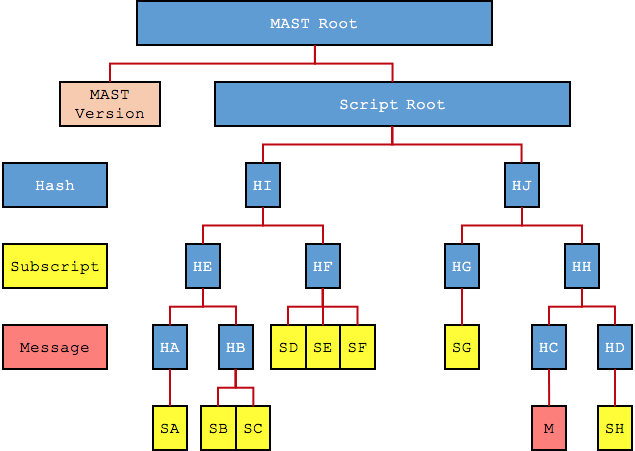
Subscript:
SA = 1 EQUALVERIFY (0x5188)
SB = 2 EQUALVERIFY (0x5288)
SC = 3 EQUALVERIFY (0x5388)
SD = 4 EQUALVERIFY (0x5488)
SE = 5 EQUALVERIFY (0x5588)
SF = 6 EQUALVERIFY (0x5688)
SG = 7 EQUALVERIFY (0x5788)
SH = 8 EQUALVERIFY (0x5888)
M = RETURN "Hello" (0x6a0548656c6c6f)
Hash:
HA = H(0x01|H(SA)) = H(0x015acb54166e0db370cd1b05a29120373568dacea2abc3748459ec3da2106e4b4e) = 0xd385d7268ad7e1ec51660f833d54787d2d8d79b6b1809d9c1d06c9e71f7be204
HB = H(0x02|H(SB)|H(SC)) = 0x7cbfa08e44ea9f4f996873be95d9bffd97d4b91a5af32cc5f64efb8461727cdd
HF = H(0x03|H(SD)|H(SE)|H(SF)) = 0x4611414355945a7c2fcc62a53a0004821b87e68f93048ffba7a55a3cb1e9783b
HG = H(0x01|H(SG)) = 0xaa5fbdf58264650eadec33691ba1e7606d0a62f570eea348a465c55bc86ffc10
HC = H(0x01|H(M)) = 0x70426d480d5b28d93c5be54803681f99abf4e8df4eab4dc87aaa543f0d138159
HD = H(0x0x|H(SH)) = 0x8482f6c9c3fe90dd4d533b4efedb6a241b95ec9267d1bd5aaaee36d2ce2dd6da
HE = H(HA|HB) = 0x049b9f2f94f0a9bdea624e39cd7d6b27a365c6a0545bf0e9d88d86eff4894210
HH = H(HC|HD) = 0xc709fdc632f370f3367da45378d1cf430c5fda6805e731ad5761c213cf2d276e
HI = H(HE|HF) = 0xead5e1a1e7e41b77b794f091df9be3f0e9f41d47304eb43dece90688f69843b7
HJ = H(HG|HH) = 0xd00fc690c4700d0f983f9700740066531ea826b21a4cbc62f80317261723d477
Script Root = H(HI|HJ) = 0x26d5235d20daf1440a15a248f5b5b4f201392128072c55afa64a26ccc6f56bd9
MAST Root = H(MAST Version|Script Root) = H(0x0000000026d5235d20daf1440a15a248f5b5b4f201392128072c55afa64a26ccc6f56bd9) = 0xb4b706e0c02eab9aba58419eb7ea2a286fb1c01d7406105fc12742bf8a3f97c9
The scriptPubKey with native witness program is:
1 <0xb4b706e0c02eab9aba58419eb7ea2a286fb1c01d7406105fc12742bf8a3f97c9>
(0x5120b4b706e0c02eab9aba58419eb7ea2a286fb1c01d7406105fc12742bf8a3f97c9)
To redeem with the
SD|SE|SF
branch, the witness is
Script_stack_1: 0x06
Script_stack_2: 0x05
Script_stack_3: 0x04
Subscript_1: 0x5488
Subscript_2: 0x5588
Subscript_3: 0x5688
Position: 0x01 (HF is the second hash in its level)
Path (HE|HJ): 0x049b9f2f94f0a9bdea624e39cd7d6b27a365c6a0545bf0e9d88d86eff4894210d00fc690c4700d0f983f9700740066531ea826b21a4cbc62f80317261723d477
Metadata: 0x03 (3 Subscript)
Imbalance MAST
When constructing a MAST, if the user believes that some of the
branches are more likely to be executed, they may put them closer to the
Script Root
. It will save some witness space when the
preferred branches are actually executed.
Escrow with Timeout
The following is the "Escrow with Timeout" example in BIP 112 :
IF
2 <Alice's pubkey> <Bob's pubkey> <Escrow's pubkey> 3 CHECKMULTISIG
ELSE
"30d" CHECKSEQUENCEVERIFY DROP
<Alice's pubkey> CHECKSIG
ENDIF
Using compressed public key, the size of this script is 150 bytes.
With MAST, this script could be broken down into 2 mutually exclusive branches: 2
2 <Alice's pubkey> <Bob's pubkey> <Escrow's pubkey> 3 CHECKMULTISIGVERIFY (105 bytes)
"30d" CHECKSEQUENCEVERIFY <Alice's pubkey> CHECKSIGVERIFY (42 bytes)
Since only one branch will be published, it is more difficult for a blockchain analyst to determine the details of the escrow.
Hashed Time-Lock Contract
The following is the "Hashed TIme-Lock Contract" example in BIP 112 :
HASH160 DUP
EQUAL
IF
"24h" CHECKSEQUENCEVERIFY
2DROP
<Alice's pubkey>
ELSE
EQUAL
NOTIF
"Timestamp" CHECKLOCKTIMEVERIFY DROP
ENDIF
<Bob's pubkey>
ENDIF
CHECKSIG
To create a MAST Root, it is flattened to 3 mutually exclusive branches:
HASH160
EQUALVERIFY "24h" CHECKSEQUENCEVERIFY <Alice's pubkey> CHECKSIGVERIFY
HASH160
EQUALVERIFY <Bob's pubkey> CHECKSIGVERIFY
"Timestamp" CHECKLOCKTIMEVERIFY <Bob's pubkey> CHECKSIGVERIFY
which significantly improves readability and reduces the witness size when it is redeemed.
Large multi-signature constructs
The current CHECKMULTISIG supports up to 20 public keys. Although it
is possible to extend it beyond 20 keys by using multiple CHECKSIGs and
IF/ELSE conditions, the construction could be very complicated and soon
use up the 10,000 bytes and 201
nOpCount
limit.
With MAST, large and complex multi-signature constructs could be flattened to many simple CHECKMULTISIGVERIFY conditions. For example, a 3-of-2000 multi-signature scheme could be expressed as 1,331,334,000 3-of-3 CHECKMULTISIGVERIFY, which forms a 31-level MAST. The scriptPubKey still maintains a fixed size of 34 bytes, and the redemption witness will be very compact, with less than 1,500 bytes.
Commitment of non-consensus enforced data
Currently, committing non-consensus enforced data in the scriptPubKey requires the use of OP_RETURN which occupies additional block space. With MAST, users may commit such data as a branch. Depends on the number of executable branches, inclusion of such a commitment may incur no extra witness space, or 32 bytes at most.
An useful case would be specifying "message-signing keys", which are not valid for spending, but allow users to sign any message without touching the cold storage "funding key".
Backward compatibility
As a soft fork, older software will continue to operate without modification. Non-upgraded nodes, however, will consider MAST programs as anyone-can-spend scripts. Wallets should always be wary of anyone-can-spend scripts and treat them with suspicion.
Deployment
This BIP depends on BIP 141 and will be deployed by version-bits BIP 9 after BIP 141 is enforced. Exact details TBD.
Credits
The idea of MAST originates from Russell O’Connor, Pieter Wuille, and Peter Todd .
Reference Implementation
https://github.com/jl2012/bitcoin/tree/bip114v2 (WIP)
//New rules apply if version byte is 1 and witness program size is 32 bytes
if (witversion == 1 && program.size() == 32 && (flags & SCRIPT_VERIFY_MAST)) {
    CHashWriter sRoot(SER_GETHASH, 0);
    CHashWriter sScriptHash(SER_GETHASH, 0);
    uint32_t nMASTVersion = 0;
    size_t stacksize = witness.stack.size();
    if (stacksize < 4)
        return set_error(serror, SCRIPT_ERR_INVALID_MAST_STACK);
    std::vector<unsigned char> metadata = witness.stack.back(); // The last witness stack item is metadata
    if (metadata.size() < 1 || metadata.size() > 5)
        return set_error(serror, SCRIPT_ERR_INVALID_MAST_STACK);

    // The first byte of metadata is the number of subscripts (1 to 255)
    uint32_t nSubscript = static_cast<uint32_t>(metadata[0]);
    if (nSubscript == 0 || stacksize < nSubscript + 3)
        return set_error(serror, SCRIPT_ERR_INVALID_MAST_STACK);
    int nOpCount = nSubscript; // Each condition consumes a nOpCount
    sScriptHash << metadata[0];

    // The rest of metadata is MAST version in minimally-coded unsigned little endian int
    if (metadata.back() == 0)
        return set_error(serror, SCRIPT_ERR_INVALID_MAST_STACK);
    if (metadata.size() > 1) {
        for (size_t i = 1; i != metadata.size(); ++i)
            nMASTVersion |= static_cast<uint32_t>(metadata[i]) << 8 * (i - 1);
    }

    // Unknown MAST version is non-standard
    if (nMASTVersion > 0 && flags & SCRIPT_VERIFY_DISCOURAGE_UPGRADABLE_WITNESS_PROGRAM)
        return set_error(serror, SCRIPT_ERR_DISCOURAGE_UPGRADABLE_WITNESS_PROGRAM);

    sRoot << nMASTVersion;

    // The second last witness stack item is the pathdata
    // Size of pathdata must be divisible by 32 (0 is allowed)
    // Depth of the Merkle tree is implied by the size of pathdata, and must not be greater than 32
    std::vector<unsigned char> pathdata = witness.stack.at(stacksize - 2);
    if (pathdata.size() & 0x1F)
        return set_error(serror, SCRIPT_ERR_INVALID_MAST_STACK);
    unsigned int depth = pathdata.size() >> 5;
    if (depth > 32)
        return set_error(serror, SCRIPT_ERR_INVALID_MAST_STACK);

    // Each level of Merkle tree consumes a nOpCount
    // Evaluation of version 0 MAST terminates early if there are too many nOpCount
    // Not enforced in unknown MAST version for upgrade flexibility
    nOpCount = nOpCount + depth;
    if (nMASTVersion == 0 && nOpCount > MAX_OPS_PER_SCRIPT)
        return set_error(serror, SCRIPT_ERR_OP_COUNT);

    // path is a vector of 32-byte hashes
    std::vector <uint256> path;
    path.resize(depth);
    for (unsigned int j = 0; j < depth; j++)
        memcpy(path[j].begin(), &pathdata[32 * j], 32);

    // The third last witness stack item is the positiondata
    // Position is in minimally-coded unsigned little endian int
    std::vector<unsigned char> positiondata = witness.stack.at(stacksize - 3);
    if (positiondata.size() > 4)
        return set_error(serror, SCRIPT_ERR_INVALID_MAST_STACK);
    uint32_t position = 0;
    if (positiondata.size() > 0) {
        if (positiondata.back() == 0)
            return set_error(serror, SCRIPT_ERR_INVALID_MAST_STACK);
        for (size_t k = 0; k != positiondata.size(); ++k)
            position |= static_cast<uint32_t>(positiondata[k]) << 8 * k;
    }

    // Position value must not exceed the number of leaves at the depth
    if (depth < 32) {
        if (position >= (1U << depth))
            return set_error(serror, SCRIPT_ERR_INVALID_MAST_STACK);
    }

    // Sub-scripts are located before positiondata
    for (size_t i = stacksize - nSubscript - 3; i <= stacksize - 4; i++) {
        CScript subscript(witness.stack.at(i).begin(), witness.stack.at(i).end());

        // Evaluation of version 0 MAST terminates early if script is oversize
        // Not enforced in unknown MAST version for upgrade flexibility
        if (nMASTVersion == 0 && (scriptPubKey.size() + subscript.size()) > MAX_SCRIPT_SIZE)
            return set_error(serror, SCRIPT_ERR_SCRIPT_SIZE);
        uint256 hashSubScript;
        CHash256().Write(&subscript[0], subscript.size()).Finalize(hashSubScript.begin());
        sScriptHash << hashSubScript;
        scriptPubKey = scriptPubKey + subscript; // Final scriptPubKey is a serialization of subscripts
    }
    uint256 hashScript = sScriptHash.GetHash();

    // Calculate MAST Root and compare against witness program
    uint256 rootScript = ComputeMerkleRootFromBranch(hashScript, path, position);
    sRoot << rootScript;
    uint256 rootMAST = sRoot.GetHash();
    if (memcmp(rootMAST.begin(), &program[0], 32))
        return set_error(serror, SCRIPT_ERR_WITNESS_PROGRAM_MISMATCH);

    if (nMASTVersion == 0) {
        stack = std::vector<std::vector<unsigned char> >(witness.stack.begin(), witness.stack.end() - 3 - nSubscript);
        for (unsigned int i = 0; i < stack.size(); i++) {
            if (stack.at(i).size() > MAX_SCRIPT_ELEMENT_SIZE)
                return set_error(serror, SCRIPT_ERR_PUSH_SIZE);
        }

        // Script evaluation must not fail, and return an empty stack
        if (!EvalScript(stack, scriptPubKey, flags, checker, SIGVERSION_WITNESS_V1, nOpCount, serror))
            return false;
        if (stack.size() != 0)
            return set_error(serror, SCRIPT_ERR_EVAL_FALSE);
    }

    return set_success(serror);
}
Copying from
src/consensus/merkle.cpp
:
uint256 ComputeMerkleRootFromBranch(const uint256& leaf, const std::vector<uint256>& vMerkleBranch, uint32_t nIndex) {
    uint256 hash = leaf;
    for (std::vector<uint256>::const_iterator it = vMerkleBranch.begin(); it != vMerkleBranch.end(); ++it) {
        if (nIndex & 1) {
            hash = Hash(BEGIN(*it), END(*it), BEGIN(hash), END(hash));
        } else {
            hash = Hash(BEGIN(hash), END(hash), BEGIN(*it), END(*it));
        }
        nIndex >>= 1;
    }
    return hash;
}
References
Copyright
This document is placed in the public domain.